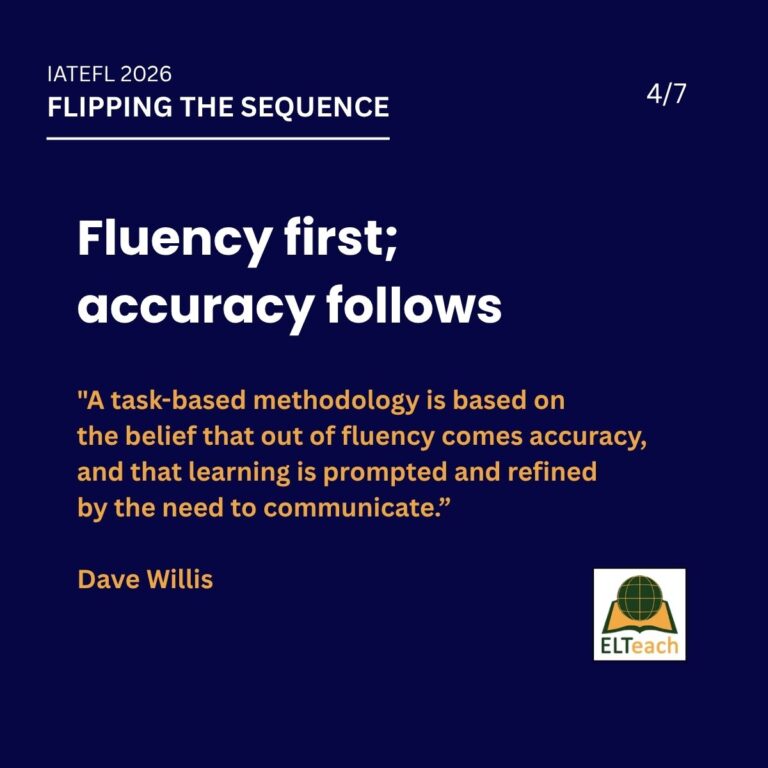
A Task-Based approach to language learning repositions the focus on specific grammar (and vocabulary) items as the subsidiary aim of lessons. The main aim is that students are better able to perform something in the real world – to do something *with* language.
Bill Van Patten (2017) tries to find some common ground between various authors’ definitions of a task:
👉 Tasks involve the expression and interpretation of meaning
👉 Tasks have a purpose that is *not* language practice.
Meaningful tasks:
– create a kind of “learning pressure”;
– allow learners to become aware of the gaps in their knowledge;
– make language learning more salient as a result.
Grammar becomes the “midwife”, as it were, rather than the main event of lessons. And if you’re at all interested in emergent language, TBL offers a valuable lesson structure which makes room both for students to focus on their own language, and for teachers to respond to their language.
Further, students are not simply chatting. Because success is evaluated by *task achievement* rather than just participation, the framework compels learners to (a) hone their own language to be precise about meanings and (b) rigorously attend to their interlocutors’ language as they work together to reach a concrete outcome such as solving a problem, reaching a decision, or creating something. This non-linguistic purpose provides the incentive for the L2 speaker to convey information with genuine precision.
It is this “need to mean” that ultimately drives interlanguage development.
In short, TBL (TBLT) guarantees a purposeful environment where learners must flex their communicative muscles i.e. “push” themselves both in terms of linguistic accuracy and complexity.
What do you do in fluency-focused lesson sequences to ensure the learners are precise with their language?