A Masterclass in Preparing Students for TOEFL
Most TOEFL teacher training courses are run by people who teach TOEFL. Ours is led by an assessment specialist who writes, vets and proofreads high-stakes language examinations for several examination boards, a published coursebook writer, and an experienced examiner and assessor. That is a combination you won’t find anywhere else.
Every session runs live on Zoom. No recordings, no self-paced modules and no talking to a screen. You work directly with specialists in language assessment and exam preparation who understand how language proficiency is assessed, what distinguishes high-scoring performances from average ones, and how to help students achieve their full potential in the TOEFL iBT.
What most courses don’t teach you — and we do
There is a gap at the heart of most TOEFL teacher training: very few courses teach you how to assess your students’ performance effectively. You can leave knowing how to teach the four skills and still have little idea whether your student is genuinely ready to take the test, why their scores have plateaued, or how to provide feedback that leads to measurable improvement.
We give that a dedicated module.
You will work with authentic scoring rubrics and real student responses, learning how to evaluate both spoken and written performance consistently and accurately. By the end of the course, you will be able to identify strengths and weaknesses with confidence, deliver constructive feedback that students can immediately act upon, and make informed decisions about when they are ready to sit the TOEFL iBT.
Whether you have never taught a TOEFL preparation class before or have years of experience preparing students for university entrance examinations, this course will transform what happens in your classroom. The techniques you learn are practical, immediately applicable and highly valued by language schools, universities, private tutoring organisations and educational institutions around the world.
Whether you teach face-to-face, online or in a blended environment, this course will equip you with the knowledge, confidence and practical tools to prepare students effectively for every section of the TOEFL iBT.
This course is offered six times a year as a complete six-module, 30-hour programme (15 hours of guided learning and 15 hours of independent study). The six core modules are delivered over six consecutive weeks.
Over six live sessions you will cover:
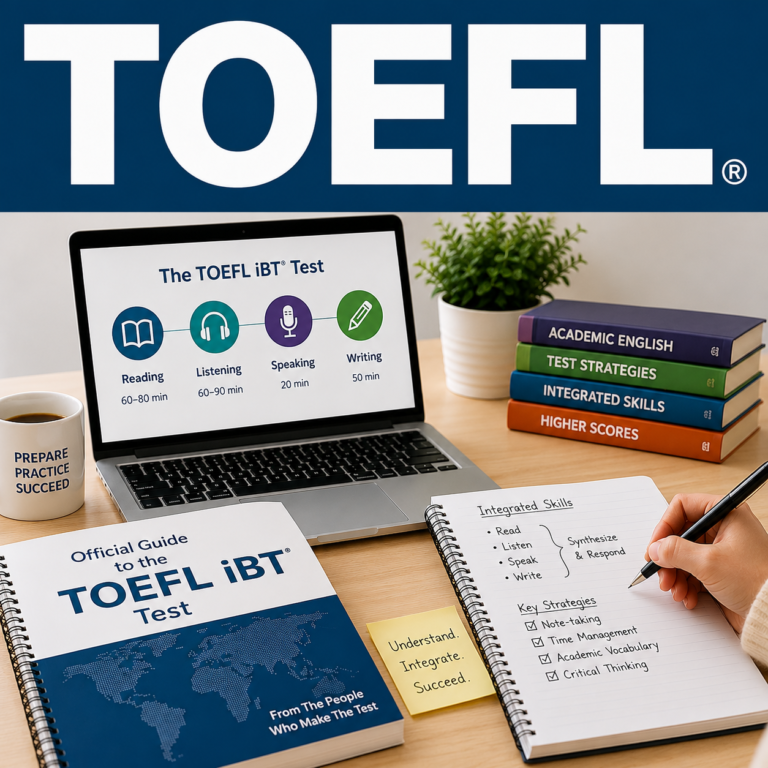
- the structure of the TOEFL iBT, its question types and the language skills assessed throughout the Reading, Listening, Speaking and Writing sections;
- how to design an effective TOEFL preparation syllabus and sequence lessons that build progressively towards the examination;
- the methodology of TOEFL preparation and how it differs from teaching General English;
- practical teaching ideas, effective classroom activities and the selection and adaptation of high-quality preparation materials;
- strategies, techniques and approaches that help students maximise their TOEFL scores;
- how to teach TOEFL successfully in both face-to-face and online learning environments;
- how to assess spoken and written performance using authentic scoring rubrics;
- formal and informal assessment techniques and how to respond effectively to student performance throughout a preparation course;
- how to provide clear, actionable feedback that enables students to improve efficiently and independently;
- strategies for developing confident, autonomous learners who can perform successfully under the time pressure of the TOEFL iBT;
- techniques for maintaining student motivation throughout what is often a demanding and academically challenging preparation programme.
Once you have enrolled, you will receive a pre-course task to complete before the course begins. This should take approximately six hours. Before each live session, you will also receive a pre-session task lasting around 60–90 minutes. Completing these tasks beforehand allows every minute of live contact time to focus on discussion, analysis, practical application and expert guidance rather than content delivery.
You will finish the course with a Certificate in Teaching TOEFL, the confidence to assess your students accurately, the ability to provide feedback that genuinely improves performance, a wealth of ready-to-use classroom activities and teaching techniques, and a much deeper understanding of the TOEFL iBT than most teachers ever acquire.
Those wishing to continue their professional development can work towards the Diploma in Teaching TOEFL by successfully completing any five of the specialist add-on modules after gaining the Certificate.
Each module runs for 2.5 hours and takes place on different days and times throughout the year, making them accessible to participants joining from around the world.
1. Planning and Teaching TOEFL Exam Preparation Courses and Classes
This module provides a clear framework for designing effective TOEFL preparation programmes, from short intensive courses to longer academic pathways. You will explore needs analysis, target score setting, syllabus design across all four skills, lesson planning, course pacing and material selection. Particular attention is given to developing students’ integrated language skills and preparing them for the academic demands of university study. By the end of the module, you will be able to design well-structured, student-centred courses that systematically build learners towards their target TOEFL scores.
2. Teaching Reading
This module focuses on the TOEFL Reading section, where candidates read academic texts and answer a variety of question types designed to assess comprehension, vocabulary, inference, rhetorical purpose and the ability to recognise how ideas are organised within a text. You will explore every major question type, together with practical strategies for developing academic reading skills, improving reading speed, teaching effective annotation and note-taking techniques, and helping students approach longer passages with confidence. The session includes a wide range of practical classroom activities and solutions to the challenges most commonly experienced by TOEFL candidates.
3. Teaching Listening
This module examines the Listening section, which requires candidates to understand academic lectures, classroom discussions and campus conversations before answering a range of comprehension and inference questions. You will learn how to teach effective note-taking, prediction, identifying key information, recognising speaker attitude and following complex academic discourse. The session also explores practical techniques for developing listening stamina and concentration, together with classroom activities that prepare students for authentic university listening situations as well as the demands of the TOEFL examination.
4. Teaching Speaking
This module focuses on all Speaking tasks in the TOEFL iBT, including both independent and integrated speaking tasks. You will develop practical strategies for teaching fluency, coherence, pronunciation, organisation of ideas and effective time management under examination conditions. Particular emphasis is placed on helping students integrate information from reading and listening texts into coherent spoken responses, while maintaining accuracy, appropriate language and confidence. You will leave with a wide range of practical classroom activities that develop speaking performance in a systematic and measurable way.
5. Teaching Writing
This module focuses on both writing tasks in the TOEFL iBT: the Integrated Writing task and the Academic Discussion task. You will explore the demands of each task, develop strategies for teaching planning, organisation, summarising source material, synthesising information from reading and listening texts, constructing well-supported arguments and producing clear, coherent academic writing under timed conditions. The session also examines common learner difficulties and provides practical classroom activities that students can apply immediately in preparation for the examination.
6. Assessing and Evaluating Oral and Written Performance
This module develops one of the most valuable skills a TOEFL teacher can possess: the ability to assess student performance accurately and provide feedback that genuinely improves results. You will learn how to evaluate speaking and writing using authentic scoring rubrics, identify strengths and areas for improvement efficiently, conduct effective mock examinations and monitor learner progress throughout a preparation programme. The module also explores error analysis, self-assessment, peer assessment and the creation of individual learning plans that lead to measurable improvement. This is the module many TOEFL teacher training courses overlook—and the one that is likely to have the greatest long-term impact on both your teaching and your students’ success.
Each module runs for 2.5 hours and takes place on different days and times throughout the year, making them accessible to participants joining from around the world.
7–10. Teaching TOEFL through Games: Reading, Listening, Speaking and Writing
These four modules demonstrate how game-based learning can make TOEFL preparation more engaging while maintaining a clear focus on examination success. You will explore a wide range of ready-to-use activities covering all four sections of the TOEFL iBT, helping students develop the language skills, strategies and confidence needed to succeed. By the end of the modules, you will have a practical toolkit of motivating classroom activities that reinforce exam techniques, encourage active participation and make even the most challenging aspects of TOEFL preparation enjoyable.
11. Teaching Academic Vocabulary
Academic vocabulary is fundamental to success in the TOEFL iBT. This module explores practical approaches to developing the range, precision and flexibility of vocabulary that students need to perform well across all four sections of the examination. You will examine the Academic Word List, academic collocations, word families, lexical chunks and discipline-specific vocabulary, together with effective techniques for helping students actively acquire and use new language rather than simply recognise it. The session also considers vocabulary development through extensive reading, listening and integrated skills practice.
12. Planning, Creating and Conducting TOEFL Mock Tests
This module guides you through the complete process of designing, administering and reviewing effective TOEFL mock tests. You will learn how to source and adapt suitable materials, recreate authentic testing conditions, manage timing across all four sections, and interpret students’ results diagnostically. The module also explores how to identify patterns of strengths and weaknesses, provide meaningful post-test feedback and use mock test data to refine both your students’ learning plans and your own teaching.
13. Teaching Integrated Writing
One of the defining features of the TOEFL iBT is its emphasis on integrated language skills. This module focuses on the Integrated Writing task, in which candidates read an academic text, listen to a lecture and produce a written response synthesising the key information from both sources. You will develop practical strategies for teaching note-taking, identifying relationships between the reading and listening texts, organising information logically and producing accurate, coherent summaries under timed examination conditions. The session also addresses the most common learner difficulties and provides classroom activities that students can immediately apply in their own preparation.
14. Teaching Academic Discussion Writing
This module focuses on the Academic Discussion writing task, where candidates respond to a discussion prompt by expressing and supporting their own ideas in clear, well-organised academic English. You will explore effective approaches to teaching idea generation, planning, organisation, argument development, cohesion, lexical resource and grammatical accuracy. The session also examines common learner weaknesses and provides practical classroom activities that enable students to produce concise, relevant and well-supported responses within the examination time limits.
15. Teaching Integrated Speaking
This module explores the integrated speaking tasks that make the TOEFL iBT unique. You will learn how to help students combine information from reading passages, lectures and conversations into coherent spoken responses while maintaining fluency, accuracy and effective organisation. The session covers note-taking techniques, response planning, time management, pronunciation, delivery and strategies for reducing anxiety under examination conditions. You will leave with a wide range of practical activities that help students develop confidence and consistently produce higher-scoring speaking performances.
Classes are kept intentionally small, with a maximum of 18 participants and a minimum of 6. This ensures every trainee gets meaningful access to the trainers and the kind of direct interaction that makes a live course worth taking.
ELTeach reserves the right to cancel a course/module if there are insufficient students (minimum 6) registered on a module/course. In this case, an alternative module/course will be offered or a full refund will be given.
A Certificate in Teaching TOEFL is awarded upon successful completion of all six core modules. Each add-on module (modules 7–15) receives its own certificate of completion. Participants who complete the full core course plus any five add-on modules will be awarded a Diploma in Teaching TOEFL.
Anyone who completes all six modules will receive 10% off any of our other courses, including CELTA and DELTA.
General Refund and Cancellation Policy
- Courses cancelled more than 30 days prior to the start of the course will receive a full refund minus the non-refundable deposit of £100.
- Courses cancelled between 21 and 14 days prior to the start of the course will be charged 45% of the course fee.
- Courses cancelled less than 14 days prior to the start of the course will not be eligible for a refund.
Cancellations must be received by us in writing (by post or email) within these timescales. No refund of fees will be made after the start of the course.
ELTeach reserves the right to cancel a course if there are insufficient students (minimum 6) registered on a module/course. In this case, an alternative module/course will be offered or a full refund will be given.
ELTeach is a very safe and caring environment for studying. To safeguard the health and safety of trainees, students and staff, we reserve the right to expel any trainee or student (e.g., in case of gross misconduct). In the event of such expulsion, no refund of fees will be made by ELTeach.
Language requirement: B2